

Dim Sum
A Charcuterie of stories for Lord Devereaux and Viscount Valegrave

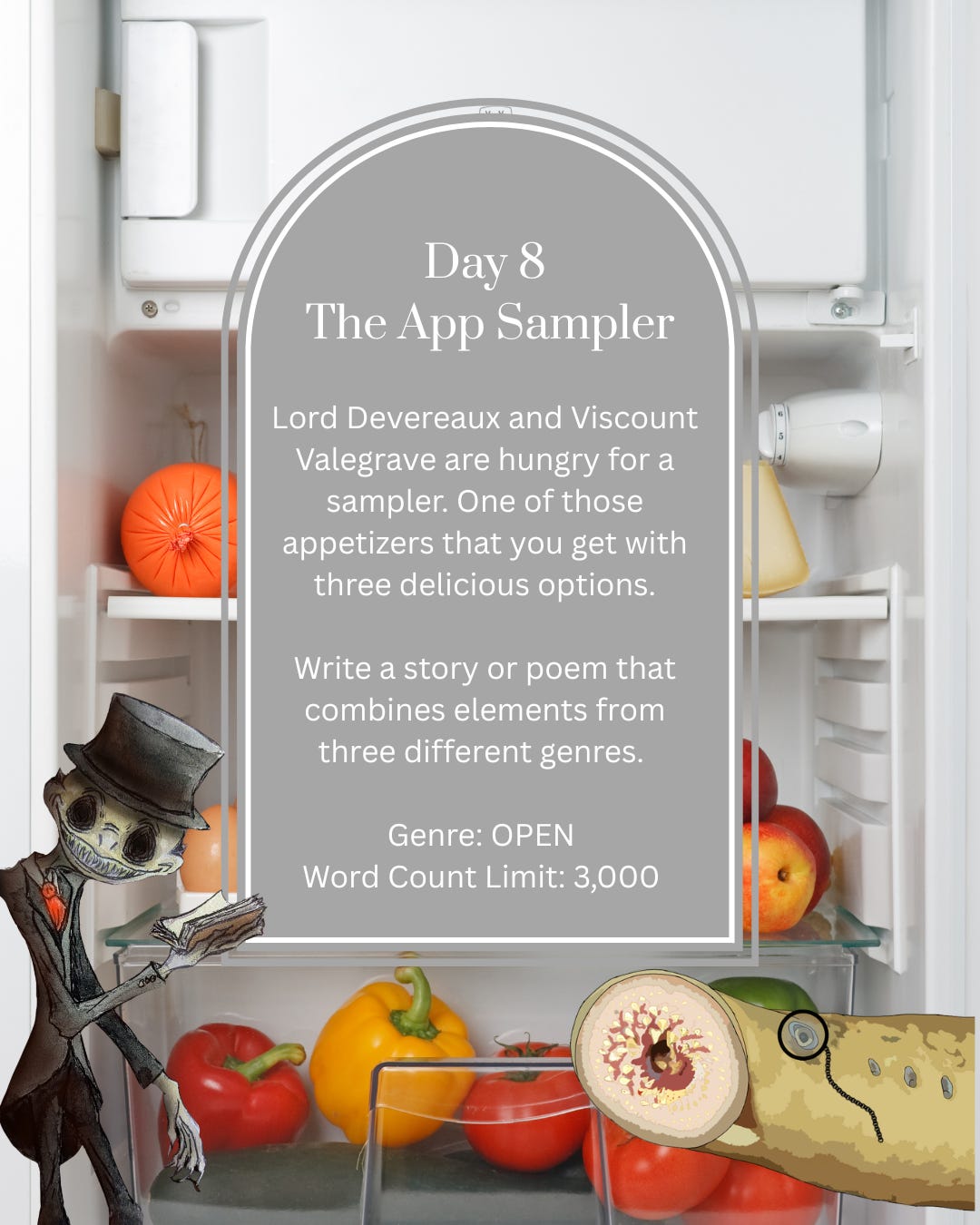
Lord Devereaux did not sit so much as arrange himself, long arms folding neatly in front of him. The stately dining room table was made of fine wood, polished to a deep shine that reflected the dim candlelight.
Around his neck, hanging like a scarf, Viscount Valegrave adjusted his monocle with a small, precise motion, his lamprey mouth tightening as he watched me through his monocle.
Devereaux inhaled, then his smile widened, a crescent that knew too much.
“Mm,” he murmured, voice dragging low, roughened at the edges like something that had learned speech by grinding it down. “Yes. There it is.”
He tilted his head toward me, as though I had always been there, as though I had been expected.
“You will write for us. My hunger grows.”
It was not a request.
“I find myself,” he continued, tapping one long finger against the table in a slow, idle rhythm, “in the mood for something sweet. Not saccharine, mind you. I’ve no patience for the artificial.” His lip curled faintly, amused by his own restraint. “No, I should like something… sincere. Earnest. But just a bite.”
Valegrave’s eye flicked toward him, the smallest acknowledgment. A warning, perhaps. Devereaux ignored it.
He leaned forward then, just slightly, as though confiding something intimate.
“Go on,” he said. “Serve it warm.”
The booth is cracked vinyl, the table still tacky where someone wiped it down too fast, but when she laughs it doesn’t matter. The sound lifts above the buzz of the fluorescent lighting above us, above the low murmur of a late shift that doesn’t quite end and doesn’t quite begin.
I tell her this place is terrible. She tells me I chose it. I say I chose her first, and that seems to settle something between us that didn’t need settling.
There’s a man two stools down arguing softly into his phone. A cook calls out an order like it’s a warning. Plates clatter. None of it really lands, though. It all presses up against us and slides away, like we’ve taken up more space than we should.
She tucks her legs beneath her on the seat, careless of the world watching, careless of anything. The hem of the red cocktail dress, the one she knows I love, rides just enough that I notice, and then notice that I’m noticing, and she catches me in it. There’s no embarrassment. Just that look she gets, like she’s already decided how this goes.
“You’re staring,” she says.
“I know,” I tell her.
She smiles like that’s the right answer.
The coffee is bad. We drink it anyway. It’s hot, and it gives us something to hold while we pretend we’re not holding onto each other. My hand finds hers between the sugar caddy and the napkin dispenser, and for a moment it feels like we’ve done something small and irreversible.
Outside, a car passes, headlights sweeping across the glass and over her face. For a second she looks like someone I’ve known much longer than I have. Not memory, something already decided.
“We should go,” she says, but she doesn’t move.
“We will,” I answer, and I don’t mean now.
The waitress asks if we want anything else. I almost say no, but she orders pie like it’s part of the plan. Like we’ve always been the kind of people who stay too long, who let the night stretch until it becomes something else entirely.
We eat it slowly. Or maybe we don’t. Time folds a little. The plate empties without either of us noticing when.
“This is stupid,” she says, but there’s no conviction in it.
“I know,” I tell her again.
She leans across the table like there’s no one else here, like the world has stepped back to give us room, and for a moment it feels true.
It feels like this is how it’s always been.
It feels like this is how it stays.
Devereaux leaned back, eyes half-lidded, savoring something that lingered beyond the words themselves. His fingers tapped once against the table, slower now, as if the rhythm had softened with the taste.
“Ah,” he said, voice low with a kind of indulgent satisfaction. “There it is. That fragile little conviction that the moment will hold. They always believe it. That’s what makes it sweet.”
Valgrave’s body shifted subtly where he lay coiled, the monocle catching a sliver of candlelight as his gaze sharpened.
“Predictable,” he replied, tone thin but precise. “But not without merit. The environment presses in, yet fails to intrude. The illusion sustains itself.”
Devereaux’s smile widened at that, pleased by the concession.
“The contrast carries it,” he said. “Filth at the edges, and still they insist on beauty. They make it, don’t they? Right there at the table. Out of nothing.”
Valgrave’s mouth tightened, considering.
“But now, let us consume something bitter, writer,” he says. “To cleanse the palete.”
She clocks them the second she comes back on shift from her smoke break.
It’s always like that. The door opens, the electronic bell ding-donging like it has for the twenty-five years she’s worked there, and she doesn’t need to look up to know what walked in this time of night. Couples carry it with them. It’s in the way they move too close to each other, in the way they don’t see anything else.
They take the corner booth like it belongs to them. Everyone thinks that booth means something.
She pours their coffee without asking. Two mugs. Cream on the side, though neither of them touches it. They don’t thank her. The girl smiles past her, like she’s part of the furniture. The man nods, distracted, already somewhere else. Together, but not here.
She’s seen this before. Not them, specifically. The way they lean in, the way their voices drop like they’re sharing something no one else could understand. As if the world hasn’t already heard it all. As if it isn’t always the same script, spoken with different mouths.
She moves through her section, takes order from the drunks who wandered in from the bar next door, wipes tables, refills cups that don’t need refilling. She watches them without watching, catching pieces as she passes. The girl laughs too easily. The man stares like he’s trying to memorize her. It’s almost embarrassing, how much they believe in it.
They stay too long. They always do. Long enough for the place to empty around them, for the noise to thin out until the hum of the lights becomes something you can’t ignore. Long enough for the illusion to settle in, to make them think this moment is separate from everything else.
When she brings the pie, the girl looks at her like she’s interrupting something sacred. It makes her want to laugh. Instead, she sets the plate down carefully, like it matters. Like any of this does.
The dress is the first real thing about her. Not the girl. The dress. Bright red, but soft enough to catch the light in a way that makes it look more expensive than it is. It rides up when she tucks her legs under herself, careless, exposing a line of skin that the man notices and tries not to.
That’s where the choice happens, in that small, thoughtless movement. The assumption that nothing can reach them here.
She clears the counter slowly, gives them time. You don’t rush this. You don’t break the spell too early. The man gets up first. Says something about paying. The girl stays behind, smiling to herself, still inside whatever they’ve built between them.
They don’t hear the footsteps behind them as they walk to their car in the empty parking lot. They never do.
Devereaux was already smiling before the last word settled, as though he had tasted it a moment early and approved of the anticipation itself. He leaned back, satisfied, one long finger tracing an idle circle on the polished wood.
“Ah,” he said, the word drawn out, almost fond. “There it is. That lovely little recoil. You feel it, don’t you? The way it curdles.”
Valgrave shifted where he lay coiled at Devereaux’s throat, the monocle catching a thin shard of candlelight as his gaze narrowed.
“Not merely bitterness,” he said. “Bitterness implies reaction. This is selection.”
Devereaux’s smile sharpened at that, pleased.
“Yes,” he agreed softly. “A refinement. The sweetness lingers just long enough to make the turn… instructive.” He tapped the table once, a quiet punctuation. “I do appreciate when the hand is steady.”
Valegrave’s mouth tightened, considering, his voice thinning further as it cut through the air.
“It understands nuance,” he said. “More importantly, it trusts it. There is no indulgence in chaos.”
Devereaux exhaled, something like contentment threading through the sound, though it never quite reached warmth.
“And still,” he murmured, eyes drifting half-lidded, “we are denied the conclusion. Teased, rather cruelly, with inevitability.”
Valegrave did not look away.
“Appropriate,” he replied. “We have not yet requested it.”
Devereaux’s gaze flicked back toward me then, bright with a quieter hunger now, more focused.
“We’ve had sweet,” he starts, “We’ve had bitter. Now… something to settle the tongue.”
They were found just past the tree line, where the gravel gives way to damp earth and the light from the diner sign doesn’t quite reach. It’s not deep woods. Just enough cover that something can happen without being seen from the road.
Detective Ramsay stands at the edge a moment before stepping in, as if there’s a line he doesn’t want to cross too quickly. The uniforms are already moving through it, careful, methodical. Someone’s marked a path with little flags that feel more official than they are.
“Couple,” one of them says, like it explains everything.
Ramsay doesn’t answer. He’s looking at the spacing. The distance between them. Close, but not as close as you’d expect. That bothers him more than anything else.
The man is on his back, eyes open, fixed on something that isn’t there. There’s a look people get at the end, Ramsay’s learned. Not fear. More like confusion that things didn’t go the way they were supposed to. The woman is turned slightly away, one arm bent beneath her, as if she’d been reaching for something she never touched.
He’s seen this before, six times in the past year. The way the bodies are arranged. The knife wounds. Always a couple.
“Robbery?” the uniform offers.
Ramsay shakes his head once. Too clean for that. No signs of a struggle worth noting. No scattered belongings. Nothing frantic. He crouches beside her, careful not to disturb anything, though he’s not entirely sure what “anything” is yet. That’s the part no one tells you about. You don’t see clues. You decide what counts as one.
The dress catches his attention. Red. Not bright, not cheap. It’s gathered slightly where the fabric pulled when she moved, or was moved. There’s dirt along the hem now, darkened by moisture, but it still holds the light in a way that feels out of place here.
“They come from the diner?” he asks.
“Looks like it,” someone answers. “Car’s still in the lot.”
Ramsay nods slowly, building it as he goes. Late night. Couple stays too long. Someone notices. Follows. Opportunity, not planning. It happens like that more often than people think. He looks back at the dress. The way it sits on her now, stilled, emptied of whatever made it matter an hour ago.
“He watched them,” Ramsay says, more to himself than anyone else. “Picked his moment. Knew they wouldn’t see him coming.”
He stands, already moving on to the next step, the next question, the next version of the story that will harden into fact if he says it enough times.
Behind him, the trees hold their silence.
Devereaux was very still when it ended, which was the closest he ever came to reverence. One long breath slipped from him, slow and satisfied, as though something had finally settled where it belonged.
“Ah,” he murmured, softer now. “There it is. Do you feel it? How it resolves.”
Valegrave did not move, but the glass of his monocle caught the light as his gaze narrowed, fixed on something only he could see.
“It resolves nothing,” he said.
Devereaux’s smile returned, smaller this time, more precise.
“Yes,” he agreed. “It asserts. A strong flavor indeed.”
His fingers tapped once against the table, a quiet punctuation, the rhythm now complete.
“The mind cannot abide the unfinished,” he continued. “Just as a fine meal cannot remain uneaten.” His eyes flicked toward you, bright with a quieter, deeper satisfaction. “And once told, once consumed in whole, it is enough.”
Valegrave’s mouth tightened, approving in the barest sense. Devereaux inclined his head, as though accepting a compliment.
“Mm,” he replied. “A most satisfying finish.”
This is a response to day 8 of Bradley Ramsey’s “Halls of Pandemonium” writing event. Although I’m not participating in the scoring portion of the event (you know, since I, uh… wrote the backend for it), likes, comments and restacks will (maybe) help us achieve community goals and spread the word about the challenge.
Lol, I see what you did there with the title. ✨🦋