

Pandemonium: The Carnival
A Day 9 Halls of Pandemonium prompt response.

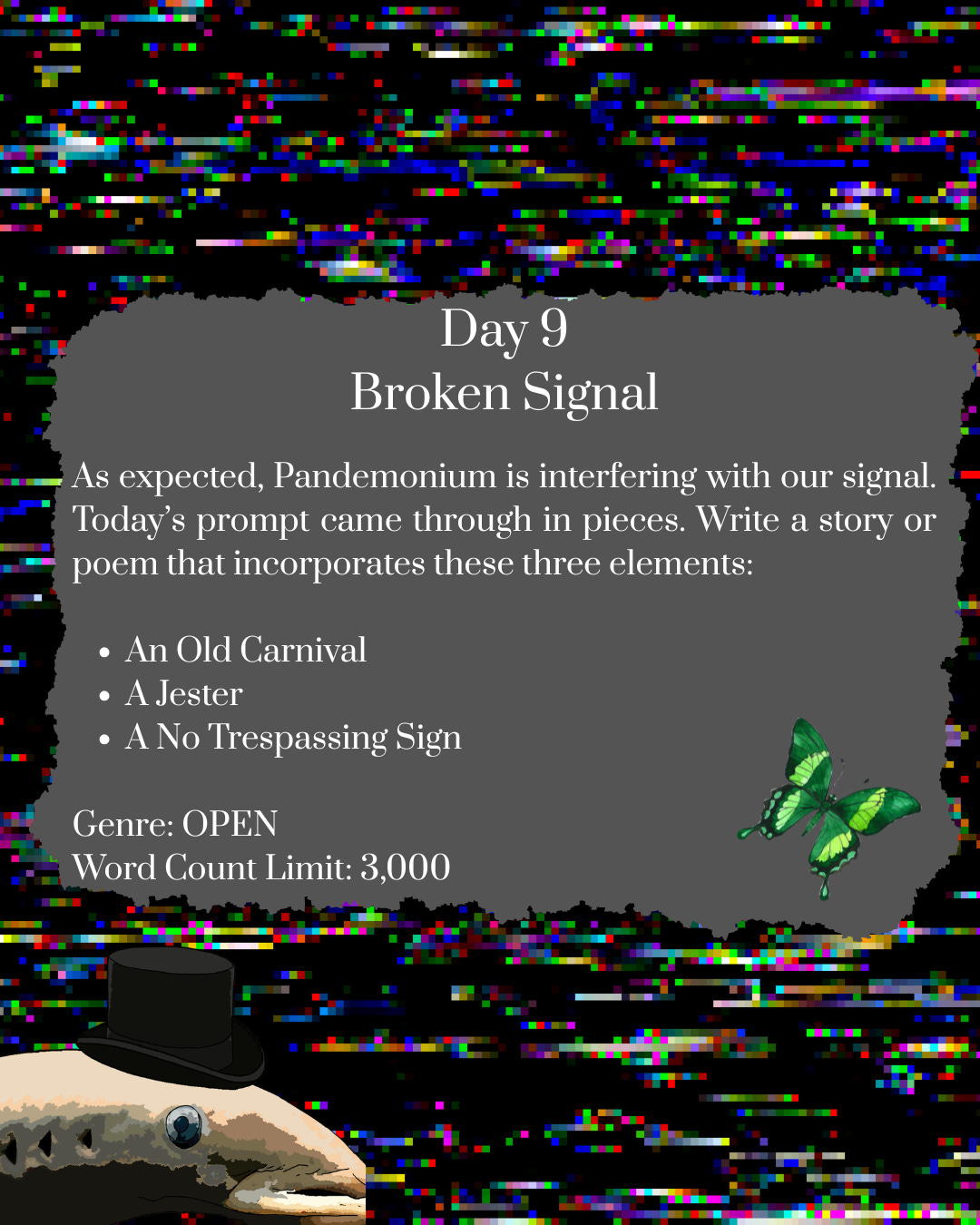
A couple days pass before I go back down to the basement. The rhythm of my routine helps with that. It gives me enough small, normal things to do that I can pretend there isn’t a sheet of plywood sitting over something that doesn’t belong under a finished floor.
I don’t tell my wife anything else. She asks once, the next morning, if I figured out what was wrong. I say it’s probably just a bad install, something with the padding. I keep it light, and she doesn’t push. I told her we’d go get what I need at the hardware store next weekend.
The part I can’t file away is Claire. Not the idea of her, more the way she was in that room. The way she moved through it like she didn’t need to check where anything was. I try to write her again that afternoon, open the same document, scroll back to the scene I was fighting with before all of this started. It looks thinner now. The lines are there, but they don’t hold the way they did in that other place. I keep catching myself trying to remember what I said to her, what she said back, like I can pull something usable out of it.
There’s a point where I stop typing and just sit there, staring at the paragraph like it might settle into something if I give it enough time. It doesn’t. It just stays what it is.
That night, I almost go down. I make it as far as the door. Hand on the handle, same as before. Nothing comes from below. No sound. No sense of anything waiting. Just a closed door and a normal house around it.
The next day isn’t much different. Work, errands, small, light conversations. Every now and then the thought of her comes back, not even clearly, more like the outline of her. The way she said my name. The way it felt like I’d stepped into something already in progress and interrupted it.
By the third night, it’s not really a question anymore. I’m awake before I have a reason to be. The house is quiet in that early way, not fully asleep, not awake either. I lie there for a minute, looking at the ceiling, trying to decide if I’m going to ignore it again.
But I already know I’m not ignoring it this time. The plywood is still there. Exactly where I left it, laid over the opening haphazardly where I dragged it when I came back. The laminate around it still pulled back just enough to show the edge. Nothing has changed. If anything, it looks more ordinary than it did before.
I slide the board aside. It scrapes lightly against the floor, a small, normal sound that doesn’t carry any farther than it should. The hole sits there under it, the same packed dirt, the same shallow drop, the same suggestion of a bottom that makes it feel manageable.
I stand over it for a moment, looking down. It doesn’t look like much. That’s the problem.
I lower myself in, one foot finding the side, the other following, hands braced without needing them.
For a second, it feels exactly like it should. But then the dirt gives way to something softer.
There’s no drop or shift in balance, rather the earth gives differently under my weight, like I’ve stepped onto something that isn’t as solid as it looks. For a moment, I think I misjudged it, that I’ve come down at a bad angle and I’m about to slide. The packed edges under my hands lose their resistance, the surface under my foot turning pliant in a way dirt shouldn’t. It doesn’t feel like falling so much as being let through.
I try to pull back, more instinct than decision, but there’s nothing to push against. The shape of the hole dissolves around me, the sense of direction going with it. There’s a brief, disorienting moment where I can’t tell if I’m moving at all, just the impression of something slipping that should have held.
I blink and when I open my eyes, I’m standing upright, weight settled evenly, like I’ve been here long enough to stop noticing how I got there.
Trees rise around me, close enough that they break the space into narrow lines, their trunks dark and slick with moisture that catches what little light there is. The canopy above is thick, more suggestion than shape, holding the sky back in a way that makes it hard to tell what time it is. There’s light, but it isn’t coming from anywhere I can point to. It just sits in the air, dim and even, like something that was measured out and left to settle.
The air feels still, but not empty. There’s a density to it, the kind that makes each breath feel slightly more deliberate than it should.
I turn, slow at first, expecting to find some reference point. The basement. The edge of the hole. Anything that lines up with where I came from. There’s nothing behind me but more of the same.
The ground stretches out in every direction without offering anything that reads as a path or a boundary. For a second, I consider staying where I am. Waiting for something to resolve. The way you do when you think a room might come back into focus if you don’t interfere with it.
That’s when I see it. A change in the light, off to my right, far enough that it takes a moment to separate from everything else. Warmer than the rest of the forest. It sits low, broken by the trunks, flickering in a way that suggests something real without committing to it.
Torchlight. The word lands cleanly, even if the distance doesn’t make sense for it. It shouldn’t reach this far. It shouldn’t hold that steady through the trees.
I stand there a moment longer, watching it, waiting for it to shift or dim or resolve into something else. But it doesn’t. It just stays where it is, quiet, like it’s been there long before I arrived and doesn’t expect anything from me.
I move toward it before I’ve decided to. The ground begins to change as I move. It isn’t immediate. At first, it’s just a difference in how my steps fall, the soft compression of leaves and moss giving way to something more worn and compact beneath it. The layer thins without fully disappearing, damp earth pressing closer to the surface, the quiet absorption of sound giving way to something that almost echoes, but not enough to place.
After a few more steps, it’s clearer. There’s a path. The ground pressed flatter than the rest, the suggestion of repetition without any sign of who or what has done the repeating. It doesn’t guide so much as it allows.
The trees begin to space themselves differently. Not thinning, exactly, but opening in a way that lets the light become clearer. The flicker turns steady a little as I get closer. It still doesn’t behave like it should. It doesn’t cast long shadows or illuminate the space between. It just marks a point.
The air changes with it. There’s a smell now. Faint dampness, but older. Not fresh earth or wet leaves. Something that’s been sitting in moisture long enough to stop being part of it. It doesn’t intensify so much as it settles in, becoming part of the air the way the light has.
I keep moving. The path curves without warning, a slow bend that feels less like direction and more like adjustment. The trees pull back just enough that I can see beyond them.
The clearing is already there by the time I realize I’ve reached it. It doesn’t open all at once. The forest gives way in increments, trunks widening their gaps, the canopy lifting just enough that the space ahead registers as something separate. By the time I step fully into it, it feels less like arriving somewhere and more like crossing a line I didn’t see.
The first thing I notice is the color. Red and white stripes stretched across canvas that sags under its own weight, the color dulled into something closer to stain than paint. The tents stand in uneven rows, not collapsed, not torn, just… held. The fabric clings to its frames as if it’s forgotten what tension is supposed to feel like.
They aren’t broken. Nothing here looks like it failed. It looks like it just stopped, like it was abandoned.
The torchlight sits at the edges of the clearing, fixed points that don’t flicker so much as they shift slightly within themselves. The flames are small, contained, casting just enough light to define the space without revealing it fully. The ground between them is darker than it should be, as if the light doesn’t reach as far as it’s supposed to.
There’s an entrance arch set back from where I stand, tall enough that it should dominate the clearing, but it doesn’t. It blends into the arrangement, part of it rather than above it. The lettering is still there, curved across the top, but it’s difficult to read at this distance, the paint worn into the same muted tone as everything else.
Balloons hang from it. Or what’s left of them.
They sag on their strings, collapsed in on themselves, the rubber drawn tight in places and slack in others, like skin that’s lost whatever filled it. A few twist slightly in the air, not moving, just held at an angle that suggests motion without ever completing it.
The smell is stronger here. A layered dampness that’s settled into everything—the canvas, the wood, the ground itself. It feels less like rot and more like something that never had a chance to dry.
I step forward without thinking about it. The ground in the clearing is different again. Harder in places, softer in others, like it can’t decide what it’s supposed to be. My foot catches slightly on something embedded beneath the surface—wood, maybe, or metal—but when I look down there’s nothing distinct enough to name.
I stop just short of the arch. Up close, the lettering exists enough to read, the edges of each character softened but still intact. The words don’t feel like they were meant to be welcoming; a statement more than an invitation.
For a moment, I stand there, looking past it, trying to see further into the rows of tents beyond. The tents aren’t the only structures. There’s a line of booths set up in front of them, arranged in a loose row that runs deeper into the clearing. Not perfectly straight, not crooked either. Just close enough to suggest order was imposed at some point in the past, then left to rot with everything else.
Games.
Closest to the arch is a ring toss. Glass bottles sit in tight clusters across the counter, their surfaces filmed over with something that dulls the reflection without fully obscuring it. The rings are still there, piled in a shallow bin, warped just enough that none of them lie flat. A few rest on the bottles where they’ve landed and stayed.
Next to it, a dart board hangs crooked against a back panel that has started to bow inward. The balloons pinned to it are long gone as balloons, the latex collapsed into thin, puckered skins that cling to the wood in irregular shapes. Darts are still embedded there, their metal dulled, feathers matted, each one fixed in a position that feels accidental until you notice the pattern they almost form.
Further down, a shooting gallery stretches into the dim. Small metal targets line the back, animals cut into simple shapes—ducks, rabbits, something that might have been a fox once. They’re fixed mid-turn, some half-rotated as if they stopped moving between one position and the next. The rifles rest on the counter, barrels angled slightly downward, like they were set down carefully and never picked back up.
The prizes hang above it all. Rows of plush toys, strung up on lines that sag under their weight. They’re recognizable at a glance—bears, dogs, bright things meant to be held—but the color has sunk out of them. The fabric is darkened, not from dirt exactly, but from something that’s settled into it and stayed. Their shapes have softened, stuffing shifting in ways that leave them slightly off, heads tilting at angles that don’t match the bodies they’re attached to.
Some of them look wet. Not dripping, more that the material clings to itself in places, pulling tight over seams, while other parts sag as if whatever held them together has loosened. A few have split just enough to show what’s inside, the stuffing discolored, clumped, no longer separate from the fabric around it.
They don’t move. None of it moves. And still, it doesn’t feel still.
My attention keeps pulling toward the center of the row, not because anything there is brighter or clearer, but because everything else seems to lean away from it without actually shifting. At first, they read the same as the rest. Just another set of prizes, hung in line with the others. Smaller. More deliberate in their shape. Then the details settle.
They aren’t plush.
Wood, painted over in colors that have dulled into the same muted tones as everything else. Faces fixed in expressions that were meant to be exaggerated, now held just shy of that. Smiles that don’t quite reach where they should. Eyes set too evenly, too round, catching the torchlight in a way nothing else here does.
Jesters. A cluster of them, strung together in the middle of the line as if they were meant to be a highlight. Their bodies hang heavier than the plush around them, the joints pulling slightly at the strings that hold them up. Their limbs don’t sit naturally. They settle into positions that feel arranged rather than fallen.
Their paint hasn’t peeled. It’s sunk. The colors sit inside the wood instead of on top of it, the lines of their faces softened without losing their shape. The hats droop at the tips, small bells at the ends darkened by time.
I stand there, looking at them longer than I mean to. There’s nothing distinct about any one of them. No movement. No change in position. Just that same sense I’ve had since I stepped through the arch—that everything here is exactly as it should be, and that includes me.
The air feels thicker here. Closer. Like it’s holding something just out of reach, waiting for it to settle into place.
I don’t notice it right away, but one of the jester dolls—middle of the cluster, slightly lower than the others, its head angled just enough that the light catches one eye more than the other. I’ve already looked at it once. Twice. Long enough to be sure of what I’m seeing.
Which is why it doesn’t make sense when it isn’t the same. The eye isn’t where it was. Not a full movement, a shift. The painted pupil sits a fraction closer to me than it did a second ago, the angle of it no longer matching the way the head is hanging. It looks wrong in a quiet way, the kind that doesn’t announce itself unless you’re already looking for it.
I hold there, trying to line it back up with what I remember. For a moment, I consider the obvious. Light. Angle. The way the torch behind me might be catching it differently now. I don’t move to test it. I don’t need to. The rest of them haven’t changed.
Just that one. Then it speaks.
“Trespasser.”
The word is small. Softly spoken. It sits in the air between us, clear enough that there’s no question of whether I heard it. The mouth hasn’t moved. The lips are still fixed in that shallow curve that isn’t quite a smile.
I don’t respond. I don’t move. There’s a space where something should follow—reaction, denial, anything—but it doesn’t arrive.
Another voice answers it from the same line, a little higher up. A different doll, similar face, similar paint, its head tilted in a way that should make the voice impossible to place.
“No trespassing.”
It isn’t louder. It isn’t more forceful. It just adds to the space, filling it in without pushing anything out.
A third joins. Then another. They don’t build in rhythm. There’s no pattern to it. Each voice lands on its own, slightly out of step with the others, some closer, some farther, some almost conversational, like they’re noting something that’s already been decided.
“Trespasser.”
“No trespassing.”
“You don’t belong here.”
The plush animals above them shift. Not all at once. Not enough to call it movement. A slight tightening in the fabric of one, a sag correcting itself by a fraction in another. A bear’s head settles into a position that doesn’t match the way it’s hanging. A seam pulls where there shouldn’t be tension.
The line of prizes stops reading as a line. It starts reading as a collection of things that are aware of where they are. The voices overlap now.
Not in unison, not a chorus. Thirty different tones, different distances, each one landing over the others without canceling anything out. It doesn’t get louder so much as it becomes impossible to separate. Every word occupies the same space at once.
“Trespasser—”
“—no trespassing—”
“—go away—”
“—you don’t belong—”
They aren’t looking at me the way something looks at a threat. They’re placing me.
I step back without deciding to. The ground catches my heel on something uneven, the surface shifting under me in that same uncertain way it had before. The arch is behind me, closer than it should be. I don’t remember moving away from it.
The voices don’t follow. They stay exactly where they are, layered over each other, continuing without escalation, like they don’t need me to be closer to keep saying it.
I turn and run. The path is there again, or it becomes one as I move. It doesn’t resist. It doesn’t slow me. The forest closes around me in the same measured way it opened, the torchlight dropping away behind the trees without ever dimming.
The voices don’t chase. They don’t need to.
My foot catches on something that wasn’t there before—a root pushing up through the ground, sharp enough to take my balance without warning. I go down hard, hands out, the soft earth giving just enough to make the fall worse.
For a second, there’s nothing.
Then laminate. My palms hit flat, the impact sharp and clean in a way the forest wasn’t.
The basement is exactly where it was. The hole is open in front of me. And the plywood is still where I left it.
This is a response to day 9 of Bradley Ramsey’s “Halls of Pandemonium” writing event. Although I’m not participating in the scoring portion of the event (you know, since I, uh… wrote the backend for it), likes, comments and restacks will (maybe) help us achieve community goals and spread the word about the challenge.