

Philly Lore: The Mummers
An outsider's look at Philly culture

It’s New Year’s Eve. In Philly that means fireworks on the Parkway. Or Rivers Casino, depending on the year and the budget.
But in Philly, New Year’s Day belongs to something else entirely. That day is claimed by men in sequins and feathers, strutting down Market and Broad Streets.
Playing banjos.
Yes. Banjos.
About a year into the long-distance courtship of my wife, I was in Philly for Christmas and New Year’s. She was cooking breakfast and turned on the parade. Channel 17.
And I saw them.
Grown men in sequins, feathers, and makeup. Banjos. Saxophones. Drummers.
“What the hell is this?” I asked, looking at her like I’d just seen Jessie from Saved by the Bell wander into a low-budget remake of Showgirls and nobody thought to warn me.
“Oh, those are the Mummers,” she said. “They parade down Broad Street every year.”
I was spellbound by the absurdity. The pageantry. This wasn’t a weird marching band playing arrangements of Earth, Wind & Fire songs. This felt older than that. I’m Looking Over a Four Leaf Clover. Auld Lang Syne. Jazz, but stripped down and reassembled with more saxophone than seemed possible.
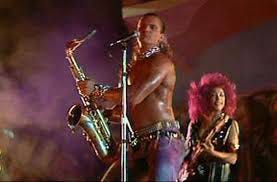
I was spellbound. I didn’t quite know how to react. I sat there while she cooked eggs in silence, watching on the small TV she had set up in the kitchen.
“You know my sister and brother-in-law are down there, right?” she said. “He’s in a string band.”
“A string band?” I asked, still staring at the TV as stormtroopers appeared on the screen.
“Yeah, that’s the music part. They’re all Mummers, but not all Mummers are string bands. There’s Comics, Fancies, Wench brigades, and string band,” she said, flipping the eggs like this was normal breakfast conversation.
“Oh.”
The skit unfolded in front of me. A lightsaber fight. Darth Vader arrived. And then, as if to make sure no one mistook this for irony, they pulled out parasols and started strutting.
Of course, I had to know more.
The Mummers aren’t a Philly original. The parade is related to the Mummers Play tradition from Great Britain and Ireland. It also blends traditions from the Swedes and Finns, who were early colonists of the Philadelphia area. They honored the medieval traditions of mummering. Get it?
But back in the 18th century in Philly, the parade was performed on “Second Day Christmas,” December 26.
Of course it involved alcohol. Most things in Philly usually does.
George Washington carried the tradition for the seven years he was a resident at the President’s House in Philadelphia.
The 1800s saw another Philadelphia tradition: taking things to the extreme. Large groups young men in disguises took to the streets on New Year’s Day, generally making a nuisance of themselves. Weapons fire, demands for free drink in taverns, organized processions, and general buffoonery abounded.
Philadelphia first tried to suppress it, then did what it always does when suppression fails: it figured out how to charge for it. Permits. Organization. Official routes. Co-option dressed up as civic stewardship. You can almost hear the adding machine ticking. It’s the same reflex that gives us the PPA, the soda tax, and the uncanny feeling that the city would meter rainfall if it could. Chaos is fine, as long as it’s insured and invoiced.
That policy produced the first officially sanctioned parade in 1901. Which means that this year, for better or worse, Philadelphia is hosting the 125th iteration of the Mummers Parade. A century and a quarter of feathers, permits, grudges, music, and men who refuse to stop showing up.
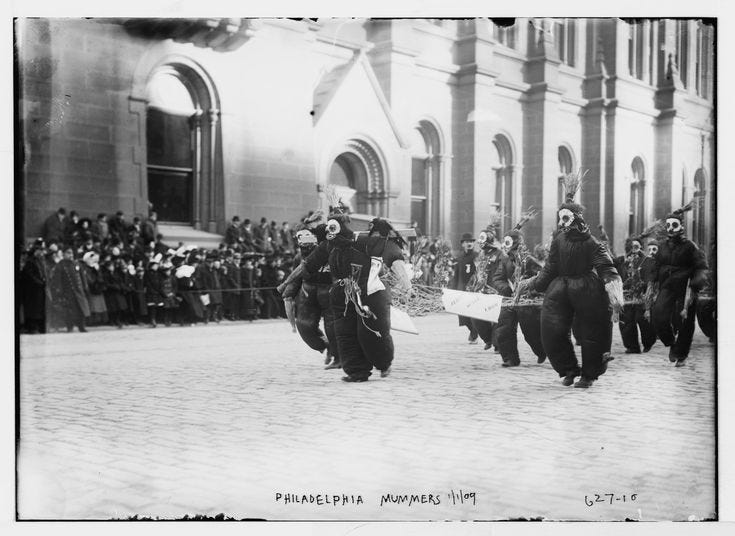
Through the years, The Mummers weren’t without controversy. For much of their modern history, blackface was a recurring and ugly feature of the parade. Not as satire or accident, but intentional and deliberate choice. It came out of the same white working-class performance traditions that produced minstrel shows across the country, a way for immigrant communities newly admitted into conditional whiteness to assert belonging by punching down. Philly tolerated it for far too long, often hiding behind tradition as a shield. When the city finally banned it in 1963, the rule didn’t cleanse the parade so much as force it to choose. Some groups adapted. Some refused. Some disappeared. But the racism persists: the vast majority of Mummers today are white men.
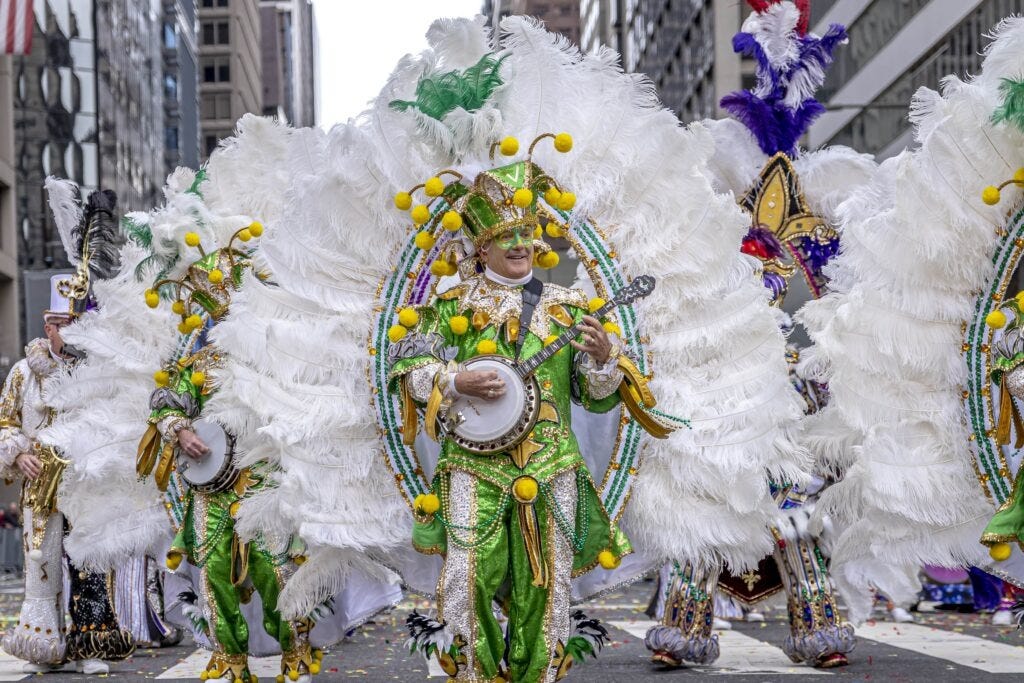
And yet the parade keeps happening. Tens of thousands of people show up every New Year’s Day, stand in the cold, and watch around 10,000 grown men in sequins and feathers strut down Market and then Broad Streets like it makes perfect sense. String bands play. Drums echo off rowhouses. Nobody pretends this is refined. That’s the point.
Sometimes the city recognizes itself so clearly that the ritual spills out beyond the parade route.
If you don’t know who Jason Kelce is, he’s the longtime, now-retired center for the Philadelphia Eagles. If that still doesn’t ring a bell, he’s the older brother of Travis Kelce, which makes him adjacent to the current Taylor Swift cinematic universe. That’s not why he matters here. What matters is that Philly knows exactly who he is.
If anyone ever needed proof that the Mummers were still alive, it got it when Kelce took the podium dressed like a Mummer and howled his way through a victory speech after Super Bowl LII. It wasn’t a joke. It was a full-body commitment to the same excess the parade has always run on. In that moment, the line between civic ritual and modern myth collapsed completely. The Mummers didn’t borrow his fame. He stepped into their language and spoke it fluently.
Today’s parade is split into modern brigades, each claiming the Mummers name while doing something very different with it. There are Comics, whose job is broad humor and skits, closer to vaudeville than ritual. There are the Fancy and Fancy Brigades, where spectacle turns competitive and the budgets balloon into something closer to mobile theater. And then there are the String Bands, where the parade stops explaining itself and just moves.
Together, the brigades turn Center City into something that doesn’t exist the rest of the year. It’s a temporary agreement about noise, movement, and excess. It’s what the city sounds like when it stops pretending to be reasonable and the Eagles or Phillies aren’t playing (let’s face it, the Sixers and Flyers are an embarrassment).
If the Mummers have a public face, it’s the String Bands. Even people who don’t know the rules, the history, or the brigades recognize the sound.
String Bands aren’t about skits or punchlines. They’re about forward motion. Banjo, bass, and drum lock together into something relentless, while rows of saxophones turn melody into mass. The music doesn’t invite you in. It runs you over and keeps going.
And String Bands don’t vanish on January 2. You hear them at other parades. Neighborhood festivals. Block parties that grow ambitions halfway through the afternoon. Sometimes you hear them because it’s Friday, the weather’s decent, and someone decided that silence was optional.
If not, they’ll just call in Philly Elmo.
But Mummers? They’ll come out in the summer and just… march. No barricades. No judges. No route map. A handful of guys in matching polos pushing sound down a residential street like they’re checking the structural integrity of the afternoon. Kids trail behind. Neighbors step onto stoops. Someone opens a beer. Nobody asks who approved this.
That’s the thing about the Mummers. They aren’t a performance you attend so much as a condition you endure and then miss when it’s gone. One day a year, the city agrees to be loud in public without apology. To dress badly on purpose. To let music spill where it doesn’t belong. To tolerate excess because it recognizes something honest inside it.
The parade survives not because it’s flawless or enlightened or easy to defend, but because it refuses to disappear quietly. It adapts when it has to. It sheds what it must. It argues with itself and keeps marching anyway. That stubbornness is the point.
On January 2, Broad Street goes back to normal. Barricades come down. Sequins get packed away. But the sound doesn’t vanish. It just waits. In basements. In garages. In a group of guys deciding that a Friday afternoon needs a little more noise while a guy fixes his car on a sidewalk.
Philly seems to understand that language. Maybe it always has.
OMG, this is wild. My stepfather loved these guys and we're down south in Baltimore. He loved the Native American outfits for the Thanksgiving Day parade when CBS still covered Philadelphia a lifetime ago for their "All American Thanksgiving Day Parade." He would always shout out "Mummers!" if we weren't in the room to summon us in. He'd still do it when we WERE in the room, lol. This post made me smile and crave a Yards anything beer. Luckily, I have plenty of those in my fridge.
My parents are from Philly and never mentioned this to me. I feel like I've missed something. Thank you for sharing!