
The Long Dark
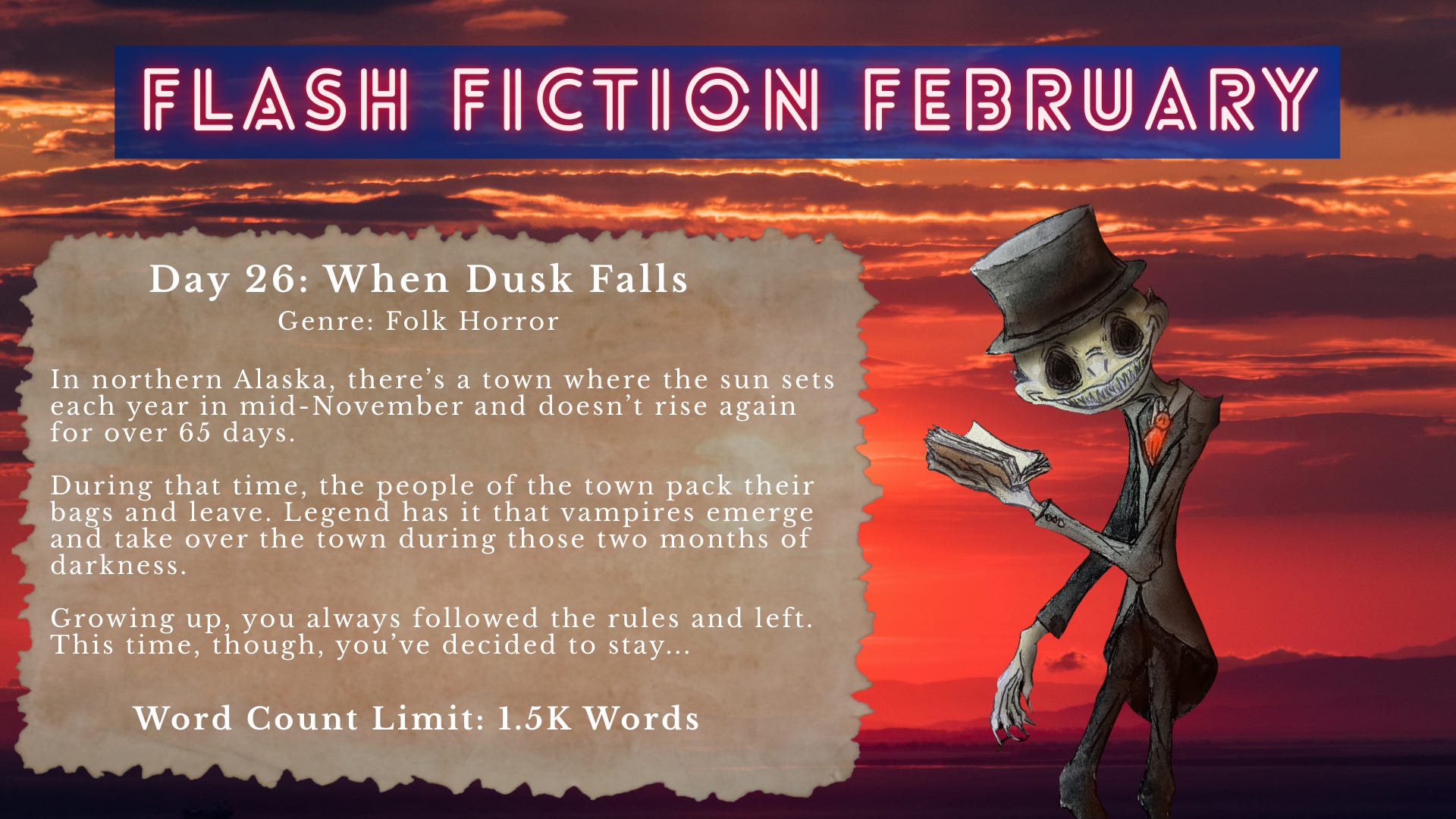
An offering to Lord Devereaux on this twenty-sixth day of Flash Fiction February.

Half the town leaves because they say the Taqriaqsuq walk when the sun goes down. The rest watched 30 Days of Night too many times and think Josh Hartnett is going to crawl out of a snowbank. I don’t believe in superstitions.
I stayed because the fuel shipment was late. That’s the whole story. Logistics. Someone had to keep the depot from freezing, and I was the one dumb enough to say yes.
If you’d asked me two months ago whether I believed in shadow-walkers or spirit echoes or anything else Annie used to whisper about behind the cookhouse, I would’ve laughed. I grew up in Anchorage, not in some carved-up campfire legend. I know how buildings settle. I know how cold behaves. I know what sleep deprivation does to people. The brain is a fragile, chemical thing that misfires in isolation. There’s nothing magical about it.
But the thing they never tell you—what I didn’t understand—is that isolation doesn’t feel like loneliness. It feels like company, the wrong kind.
The first week was fine. Loud heater, bad coffee, books with half the pages missing. Storms came in low and hard, but I’ve lived through worse. I kept the schedule taped to the wall. Wake. Check tanks. Walk the yard. Make notes. Keep the lights on longer than necessary. Sleep if I could.
Then the noises started. Ordinary noises. The kind I’ve explained a hundred times to new hires. Nails shrinking in the cold. Ice forming behind the siding. The wind pushing against the frame in slow waves. But they didn’t sound random. A small knock on the north wall at the same hour two nights in a row. A creak in the attic that made the lamp flicker. Things you can explain individually but not as a sequence.
I caught myself listening for them, and that’s when the trouble actually began.
On what I think was the tenth day, I woke with the sense someone had walked out of the room a moment earlier. It wasn’t fear, more like a disturbance in the air, the way you notice heat rising from a road before you see it. There was a wet ring by the door, a small circle of melted snow around my boots. They were dry. I hadn’t been outside. I checked the ceiling, the vent, the heater. Nothing leaked.
I told myself I tracked it in half-asleep. That was the story I chose because I didn’t like any of the alternatives.
The next day I found my gloves stacked neatly on the table. I don’t stack anything neatly. I don’t fold hotel towels the right way. Stein used to give me grief for leaving my tools everywhere. But there they were, lined up like someone had placed them for inspection.
I blamed it on being half-asleep. It was a bad excuse, but it was the only one I had. That’s what a mind does alone: it invents reasons, even bad ones.
After that came the photograph.
I keep one picture of my sister tucked in my duffel. Been carrying it for years without looking at it. I don’t know why I brought it up here. Habit, I guess. Memory you don’t want but can’t throw out. One morning it was sitting in the center of the table, unfolded, smoothed flat. I don’t remember taking it out. I would’ve felt it if I had. Even the thought of touching it makes something inside me lock up.
That was the first time I said her name out loud since coming here. That’s how I knew I was in trouble.
I started hearing footsteps on the roof after that—slow, spaced out, too heavy for animals. The rational explanation is ice shifting, but ice doesn’t choose a pace. Ice doesn’t wait.
On the radio, Stein asked if I was sleeping.
“Enough,” I said.
“Seeing anything?”
“Shadows.”
He got quiet. “Shadows inside or outside?”
“I don’t know,” I told him. “Does it matter?”
I stopped calling after that. I didn’t want him hearing what I sounded like.
The first time I saw it—whatever “it” means—it was nothing more than a dark line crossing the yard. Human height, motion without detail. Not a body. A disturbance. A suggestion. It was gone before I could turn my head.
That was when the house changed. I don’t mean in a supernatural way; I mean my perception of the house. Every surface felt watched. Every room had its own temperature like someone had been moving through ahead of me. The hallway felt narrower. The bedroom felt too open. My thoughts felt noisy in a way that made me hold my breath, as if I didn’t want to be overheard by something that didn’t breathe back.
The knocks kept coming. One each night. A signal, if I wanted to believe signals existed.
Maybe I did.
I tried staying awake for two straight days, thinking it would prove something—either that the noises were in my head or that they weren’t. All it proved was that exhaustion strips away the protective layer between reason and instinct. Once that was gone, the dark had me.
I woke standing in the kitchen once. Another time with the door half-open and my boots on, as if I’d been in the middle of leaving. The worst was waking with the sense that someone had just spoken my name. The tone wasn’t threatening. It was familiar. That scared me more.
By then the idea of the Taqriaqsuq had crawled under my skin. I didn’t believe in them, not really, but belief isn’t binary. It’s a slope. Each unexplained thing nudges you a little farther down, and the bottom comes sooner than you expect.
The house felt wrong in the way you feel wrong before a fever breaks. Like it wanted me out, or wanted me to admit something I’d been avoiding. The photograph stayed on the table for days because I couldn’t bring myself to touch it. I walked around it like it was cursed.
Today—if today means anything—I realized I couldn’t stay here another hour. It wasn’t fear. It was certainty. The kind of certainty that settles inside your ribs and refuses to be negotiated with. Staying meant drowning in thoughts that didn’t feel like mine. Leaving meant cold and dark, but at least they follow rules.
I dressed methodically—layers, boots, scarf, parka. Filled a thermos. Checked the flashlight twice. The practical rituals gave my hands something to do that wasn’t shaking.
I told myself I’d walk to the relay hut. Two miles. A familiar path. The kind of thing someone with working legs and bad judgment could manage, even in waist-deep snow.
But that’s not the real reason. The truth is simpler and uglier: the dark outside feels safer than the silence inside. Whatever is happening here—hallucinations, stress, or the echo of something older than stories—I can’t meet it in this house. Not alone. Not with the weight of that photograph on the table.
Maybe I’m being followed by my own past. Maybe I’m being watched by nothing at all. Maybe the Taqriaqsuq are only the shape isolation makes when a mind starts to bend.
It doesn’t matter anymore.
I open the door. The cold slaps my face. The world outside is a black field, empty and absolute. No stars. No horizon.
I tell myself the relay hut is close. I tell myself I’m still oriented. I tell myself I’m not walking toward anything.
And then I do the one thing I’ve been avoiding since the first night.
I step out into the cold.
This is a response to Day #26 in Bradley Ramsey’s Flash Fiction February event.
I realize I have no chance in hell to actually “win” this… Ok, uh.. so maybe a tiny, itty-bitty chance in hell to win this. But if you like this story, please like, restack, and/or comment. That’s how the stories are highlighted and judged during this event.
This is, please excuse the pun, chilling. The dread, all of it.
Damn good psychological horror. The slow erosion of reality felt authentic. I am a visual reader and could see and "feel" felt the isolation "become" the monster. Your prose was "controlled dread" and landed really well. This is good!