

The Spark
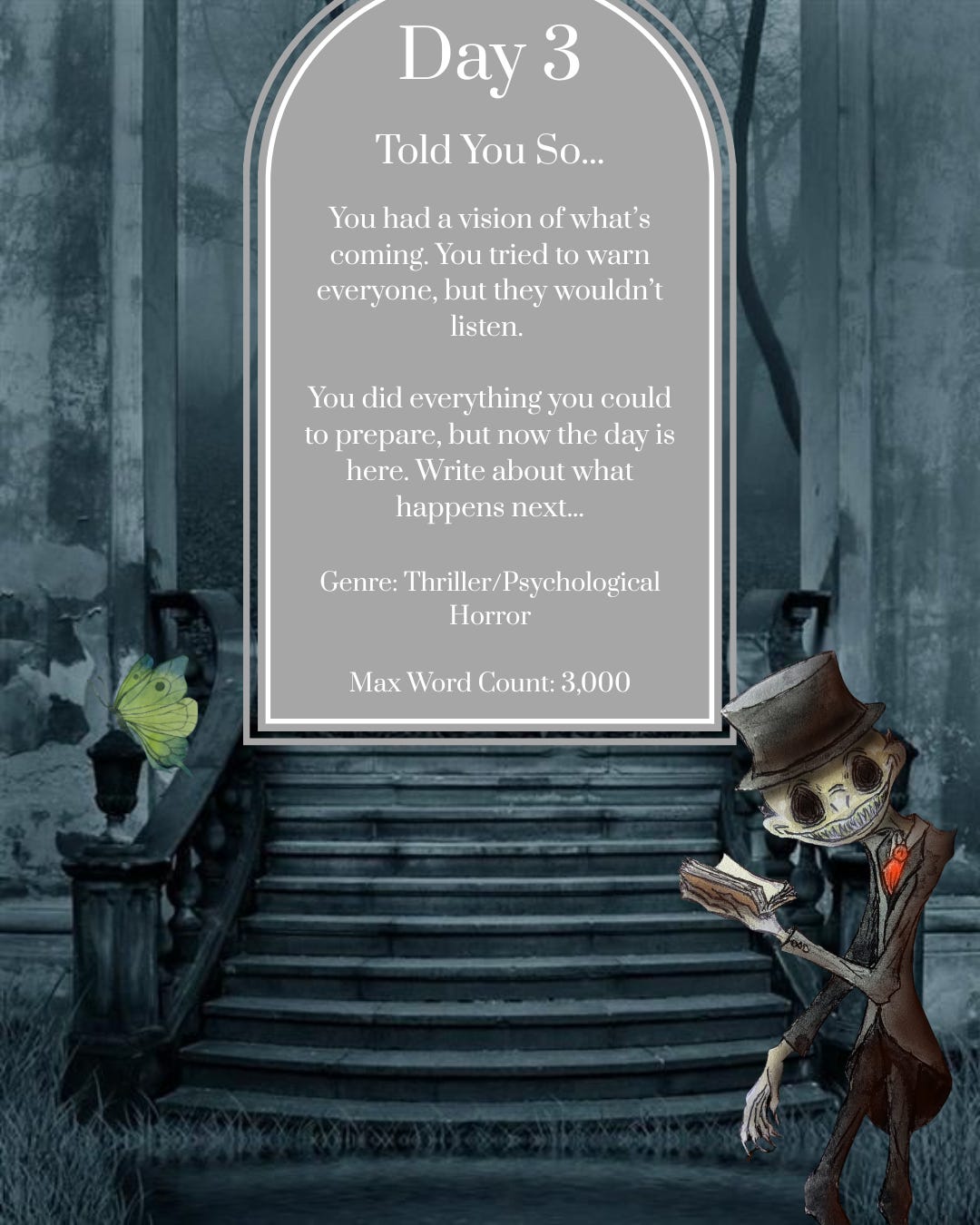
A Halls of Pandemonium Day 3 Story

By the time David turns onto her street, the day has already thinned in ways he can’t explain to anyone who hasn’t been watching for it. The light is too even. Shadows don’t quite settle where they should. A man at the corner stands with his phone held out in front of him. He smacks it once, then lifts it toward the sky.
He parks where he used to park, leaves the engine running for a moment, then shuts it off and listens. The silence isn’t total—there’s still the distant movement of a car somewhere, but the usual layer of small noise is missing. No birds. The cicadas aren’t singing.
He goes to the door and knocks once.
Inside, Jennifer hears it over the television. She is at the sink, rinsing a mug, the news running low behind her. She turns the faucet off and stands still, as if the house might give her another sound to confirm what she already knows. It doesn’t.
She opens the door and stops there, her hand still on the edge.
“We’re signing tomorrow,” she says.
“I know.”
He doesn’t hold anything. No papers, no folder, nothing that would make this visit make sense in the way she has prepared for.
“You could have called.”
“I could have.”
She looks at him, then past him, out toward the street. The brightness makes her narrow her eyes. The sky looks washed, like the color has been turned down rather than covered over. A car rolls through the intersection too slowly, then stops for no reason she can see.
She looks back at him.
“You shouldn’t be here like this,” she says. “The lawyers said—”
“Jen,” he says.
He says it without urgency. That more than anything unsettles her. She steps back and lets the door open wider.
“You’ve got ten minutes, then I need to go to work,” she says.
“I’ll only need five,” he says, and steps into the house.
They pass through the living room. The television is talking to itself, voices layered and slightly out of sync. As they pass, a phrase cuts through clearly—solar activity at levels not seen in recorded history—and then dissolves into cross-talk again.
Jennifer moves to the kitchen because it gives her something to do. She reaches for a mug, then stops with her hand still in the cabinet.
“I can’t do this again,” she says, not turning around.
David stands at the counter, looking at the small things—the knife block, the bowl of fruit, the place where he tossed his keys when he lived there. There is a faint vibration in the house, not enough to move anything, just enough that he feels it when he stands still.
“I’m not here for that,” he says.
She closes the cabinet and turns.
“Then why are you here?”
He meets her eyes and holds it, the way he didn’t use to.
“It doesn’t matter anymore.”
She exhales, the tightness leaving her shoulders.
“It always mattered,” she says. “Everything did. You just decided what was important and the rest of us had to live around it.”
“The visions, David. It changed you.”
He nods once.
“I know.”
The lights above the counter swell, not flickering, just brightening past what they should be, then easing back down. Neither of them comments on it. The television volume rises for a second on its own, a voice cutting in with forced calm—there is no cause for panic—before dropping again.
Jennifer glances toward the living room, then back at him.
“You said this before,” she says. “You were sure then, too.”
“I was,” he says.
“And now? You said this before,” she says. “You were sure then, too.”
“I was,” he says.
She watches him for a moment, waiting for the rest of it; the explanation, the correction, the argument that used to follow. When it doesn’t come, her expression tightens instead of easing.
“You had charts last time,” she says. “Dates. You said it was lining up. You said it was the same pattern.”
He doesn’t answer.
“You stopped sleeping,” she goes on. “You missed everything waiting for it.”
“I know.”
“You missed my sister’s wedding,” she says. “You told me you’d come for the reception. You didn’t.”
“I know.”
Her mouth opens like she’s going to keep going, then closes again. The repetition isn’t what she expected. It leaves nowhere for the argument to land.
“You kept saying it was like that old one,” she says after a second. “The one that knocked out the telegraphs. You said we had time to prepare.”
“I thought we did.”
She lets out a short breath, not quite a laugh.
“And then nothing happened,” she says. “Just… nothing. And you kept waiting for it anyway.”
He looks at her, steady, without the edge he used to carry.
“I was wrong,” he says.
The lights above the counter swell again, not flickering, just pushing brighter than they should before easing back. The refrigerator hum deepens for a second, then settles into her, uneven. Jennifer glances toward the living room. The television cuts through the low noise for a moment, a voice trying to hold shape against interference.
“…levels not seen in recorded history… communications disruptions expected… no cause for—”
The sentence breaks apart into static and overlapping voices.
She steps into the doorway and reaches for the remote, turning the volume up, then down again when it distorts. The screen stutters, the image slipping a fraction out of sync with the sound before catching itself.
“Is that—” she starts, then stops.
David doesn’t move. She looks back at him.
“That’s not normal,” she says.
“No.”
She stands there a moment longer, the remote still in her hand, then sets it down without turning the television off.
“You said it was lining up again,” she says, quieter now. “A few months ago. You sent me that email.”
“I know.”
“I didn’t read it.”
“I know.”
The house gives a faint shudder, not enough to move anything, just enough that the glass in the sink taps once against the basin. The lights dim a fraction this time before returning. Jennifer looks toward the window. The brightness outside has flattened further, the color drained down to something pale.
“David,” she says, and there’s something different in it now, less certain, more searching. “If this is—”
The word doesn’t come. The air pulls it apart before she can finish. He steps closer, not abruptly, just enough to close the distance he kept when he came in.
“I’m not here to convince you,” he says.
She turns back to him, her expression caught somewhere between frustration and something she doesn’t want to name.
“Then what are you here for?”
He holds her gaze.
“I didn’t want to be anywhere else when it comes.”
For a moment, she doesn’t respond. The room hums softly around them, the television continuing its broken attempts at coherence in the next room.
“That’s not an answer,” she says, but it comes out softer than she intends.
“It’s the only one I have.”
The lights swell again, brighter this time, holding there a beat too long before easing down. Somewhere outside, a sharp electrical pop, followed by a spreading silence. Jennifer doesn’t look away from him this time.
“What’s happening?” she asks.
He doesn’t look at the window. He doesn’t look at the television.
“It’s here,” he says.
They don’t speak again. The television continues in the next room, its cadence breaking and reforming, a voice trying to hold authority as it thins into noise. The lights above the counter lift once more and do not settle this time. They hold, too bright, flattening the color out of everything they touch.
Jennifer turns her head toward the window. The sky has changed without a moment to mark it. The blue is gone, not replaced by cloud but by something pale and hard, a brightness that seems to come from everywhere at once. Along the horizon, color gathers where it shouldn’t—green threaded with a deeper violet, a low band that moves with a slow, deliberate cohesion, as if the air itself has been given shape.
A line of light rises from the edge of the world. It doesn’t arc or fall. It advances.
At first it looks like heat shimmer, the kind that distorts distance on a long road in summer. Then it thickens. The distortion resolves into structure; filaments, branching, drawing themselves across the sky in long, continuous strokes. They connect to nothing and to everything, tracing paths that ignore distance, stitching horizon to horizon in a pattern that does not repeat.
The glass in the window rattles softly. Jennifer’s hand finds the back of a chair, steadying herself, though the floor hasn’t moved. The sensation is not motion but pressure, a tightening of the air that makes each breath feel measured.
David steps closer. Outside, a flash along the street; quick, sharp, gone. A second later, another, farther off. The flashes begin to multiply, not in rhythm but in accumulation, points of contact where the light reaches down and touches the ground. Wherever it touches, the color deepens, brightens, holds.
The first sound arrives late. It is not thunder. It is a low, continuous crackle, like something being taken apart one small piece at a time. It carries through the walls, through the floor, through the frame of the house until it feels less like a sound and more like a condition.
The television cuts out mid-sentence. The sudden absence lands harder than the noise that preceded it.
For a moment, there is only the vibration. Jennifer turns back to him. Whatever she had been holding onto—argument, dismissal, her disbelief—has fallen away without ceremony. What remains is simple and unguarded.
He reaches for her. There’s no hesitation in it, no second thought. His hand finds hers, and this time there is nothing between them to interrupt the contact.
Her fingers close around his as the air sharpens. A thin line of light crawls along the edge of the counter, a narrow filament that traces the grain of the wood before slipping away. The metal of the sink ticks softly, heat or current or something between the two passing through it.
They move closer without speaking, drawn by the same small instinct that has outlasted everything else. His hand comes up to her face, not urgently, just to confirm that she is there. Her skin is warm under his palm, a familiar fact in a world that has begun to shed its certainties.
Outside, the advancing line reaches the houses at the far end of the street. There is no explosion. No burst. The light touches, and the edges of things begin to soften.
Paint pales first, colors draining as if washed through. The outlines of roofs and windows lose their sharpness, the straight lines bending into a thing less defined. The structures do not collapse so much as loosen, their shapes held together by less with each passing second.
The crackle deepens. Jennifer leans into him. He feels the weight of her, the exact measure of it, the way it fits against him without adjustment. He lowers his forehead to hers, closing the small distance that remained.
“I should have—” she starts, and stops.
He shakes his head once. Not a correction, an end to the sentence. Her breath catches, then steadies. His does the same.
The light outside fills the window now, no longer distant, no longer confined to the horizon. It presses inward, not as a force but as a presence, a brightness that refuses shadow. The room responds in small ways—the edges of the table blur, the line where wall meets ceiling softens, the space itself losing its precision.
His hand slides from her cheek to the back of her neck, holding her there as their faces draw together. The kiss is not rushed. It is not a reclaiming or a promise. It is simply correct, arriving without effort, without the need to be anything more than it is.
The first filament crosses the threshold of the room.
It moves along the floor, a thin, luminous thread that traces the seam between boards before lifting, rising into the air between them. It hums as it passes, a sound too fine to separate from the larger noise surrounding it.
Jennifer’s grip tightens in his shirt. He feels it, answers it, his arm pulling her closer. The brightness increases again. Not a flare—just more light. More of whatever has replaced the sky entering the room.
The edges of their hands begin to soften where they meet. He holds on. She does not pull away.
The room dissolves by degrees, the familiar giving way without resistance. The counter, the chairs, the doorway—each loses its outline, its claim to solidity, until there is only suggestion where there had been form.
Their faces remain close, breath shared, the space between them reduced to nothing. He feels her there. That is the last stable thing.
The light moves through them. It’s not hot, it doesn’t hurt. It’s a quiet undoing, a gentle removal of the boundaries that kept one thing separate from another. His hand against her skin becomes less certain, the distinction between contact and absence thinning until it cannot hold.
For a moment that does not stretch or break, they remain as they are—two forms held together by the simple fact of choosing not to separate.
Then even that begins to loosen.
The last thing that holds is the point where they meet, the small, shared center that resists for no reason other than that it can. Then it, too, gives way. Light fills the space where they were, complete and unbroken. The house stands around it for a moment longer, empty of them, its shape already softening.
Then the brightness passes through, and there is nothing left to hold it back.
This is a response to Day 3 of Bradley Ramsey’s “Halls of Pandemonium” writing event. Although I’m not participating in the scoring portion of the event (you know, since I, uh.. wrote the backend for it), likes, comments and restacks will (maybe) help us achieve community goals and spread the word about the challenge.
Well, geez. Not what I was expecting, but wow.
You are a marvel; I feel so moved by the work. Using Rapture-language with an alien sentience probing and seek was just wonderful. I also believe I can see where your own mastery of coding has created a master writer - I think a lot of people don't realize how scripted coding has become - at least in my work with python - that is 100% the same as storytelling. In your work I see clear function with each line a specific action essential exactly where it is supposed to be and nowhere else. Bravo.