

The Tea House
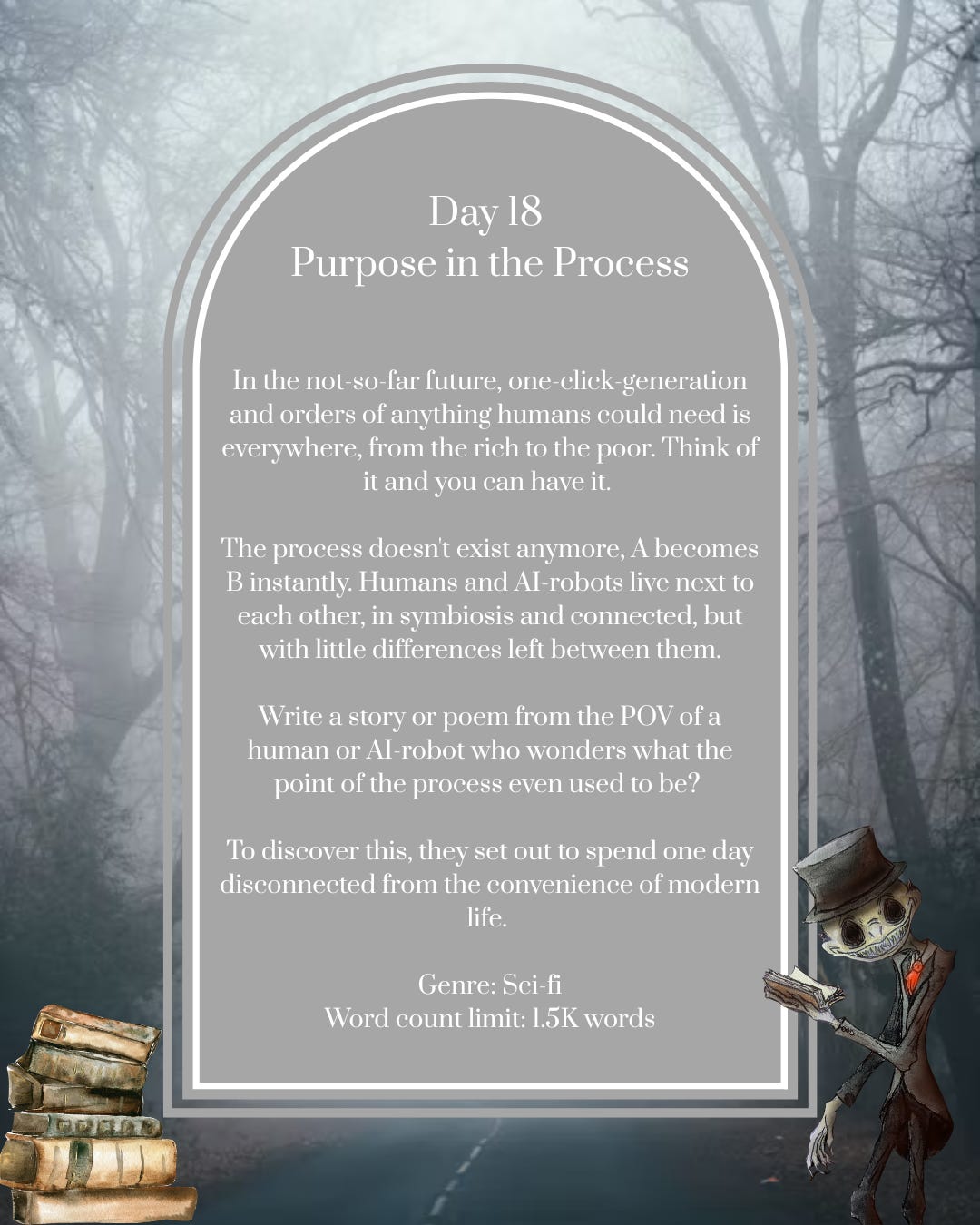
A Halls of Pandemonium Day 18 Prompt Response

Adam found the teahouse by accident, which was strange, because almost nothing happened by accident anymore. The city had been organized into something frictionless years ago. Doors opened before you reached them. Lights adjusted to your mood. Meals arrived the moment you thought about hunger for longer than a second. Most people moved through their days like water through polished pipes, guided gently from need to fulfillment with as little interruption as possible.
Rain drifted softly through the glow of the streetlights and neon signs, silver and gold and purple against the dark. Somewhere overhead, silent delivery drones crossed paths like migrating birds.
Adam had nowhere particular to be. That feeling had become increasingly common. He turned down a narrow side street he didn’t remember seeing before. Halfway down the block, tucked between two seamless white buildings, sat a narrow storefront with amber light glowing behind fogged glass.
The sign above the door read:
The Last Teahouse
The lettering looked hand-painted.
Adam stopped beneath the awning, rain ticking softly against the fabric overhead. The windows were imperfect. Tiny distortions rippled through the glass. Inside, shadows moved slowly through warm light.
The door opened before he touched it. Not automatically, though; someone inside opened it.
An older woman stood there holding the handle. Gray streaked through her dark hair, pinned loosely behind her head. She wore an apron dusted with flour or tea leaves or something else organic enough that Adam couldn’t identify it immediately.
“You coming in,” she asked, “or just inspecting the door?”
Adam blinked once. “I haven’t decided yet.”
“Well,” she said, stepping aside, “the rain already made its choice.”
The room smelled warm. Not artificial-warm from the climate control system, but from steam and wood and citrus and something faintly floral underneath it all.
The tables didn’t match, either. One was dark oak with a burn mark near the edge. Another was circular marble cracked delicately through the center and repaired with gold lacquer. The chairs looked collected instead of manufactured. None of them belonged together, but somehow the room did.
A record played softly somewhere behind the counter. Actual vinyl, unless Adam was being tricked by an extremely expensive imitation.
Five people sat at a long counter. Nobody looked at a screen. Nobody spoke above a murmur. One man sat reading an antique paper book slowly enough that it seemed intentional. A younger woman leaned against the window with both hands wrapped around a cup, staring out at the rain like there were answers in the raindrops.
Nobody seemed rushed.
The woman behind the counter motioned toward an empty stool.
“Sit wherever you’d like.”
The counter itself was worn smooth in places from years of contact. Human contact. Thousands of absentminded fingertips and elbows and cups set down gently after long conversations.
The woman filled a kettle from a sink instead of using a generator tap. Adam watched her place it on an actual gas flame.
“You do this manually?” he asked before he could stop himself.
She glanced over her shoulder. “I do most things manually.”
“Why?”
The question left his mouth with more sincerity than judgment. The woman smiled faintly, like she’d heard it before.
“Tea takes a little patience,” she said. “Otherwise, it’s just flavored water.”
Adam almost responded that patience itself had become optional decades ago, but something about the room made the sentence feel rude, so he stayed quiet. The kettle began to rumble softly.
The woman selected a small tin from a shelf lined with dozens of others. The labels had faded from handling. She measured loose leaves by hand into a ceramic pot, then paused briefly with her fingers resting against the lid, as though listening for something.
Adam found himself watching every movement. Nothing in the process attempted to eliminate the person performing it. She never asked what he wanted. She watched him quietly instead while the kettle began to whistle softly.
“Lavender,” she murmured. “And citrus, I think.”
Adam looked up.
“You look like a citrus kind of person.”
“Is that a real thing?”
“Tea’s a real thing,” she said. “People are harder.”
She took it off the heat and poured the water slowly. Steam curled upward in pale ribbons. The room smelled suddenly alive. The citrus sharpened. Floral notes opened underneath it. Something earthy lingered behind everything else like rain settling into soil.
Adam realized he’d never watched someone make tea before. He’d consumed thousands of generated variations over the years. Precise nutritional calibrations. Exact temperatures. Mood-responsive chemical balancing. Every cup mathematically perfect.
This felt different in a way he couldn’t immediately organize. The woman carried the cup over carefully and placed it in front of him. The ceramic was uneven near the rim. Tiny ridges pressed against his fingertips.
“Careful,” she said. “It’s honest.”
Adam looked up. “Honest?”
“It’ll tell you when it’s hot. Most things don’t anymore.”
Then she walked away before he could ask what that meant.
He wrapped both hands around the cup. Warmth settled into his palms slowly. The steam carried hints of orange peel and lavender and something darker beneath them all. Around him, the room continued existing at its own pace. The man reading turned a page. Someone laughed quietly near the front window. Rain tapped softly against the glass. The record crackled once before continuing.
Adam took a sip. The taste lingered differently than he expected. The first taste was floral and light, but something richer unfolded afterward, lingering at the back of his tongue with a bitterness gentle enough to feel intentional.
He took another sip immediately, trying to understand it. The woman behind the counter noticed and smiled without looking surprised.
“You can’t rush tea,” she said. “It shows itself in pieces.”
Adam stared down into the steam.
Outside, the city continued moving in seamless silence. Orders fulfilled. Needs anticipated. Desires answered before they fully formed.
Inside, water boiled slowly in kettles. People waited. Nobody seemed interested in correcting the delay.
And for the first time in longer than he could remember, Adam stopped thinking about what came next. He simply sat there, holding the cup while the rain moved softly through the dark beyond the windows, letting the tea become whatever it was becoming one sip at a time.
This is a response to day 18’s prompt for Bradley Ramsey’s “Halls of Pandemonium” writing event. Although I’m not participating in the scoring portion of the event (you know, since I, uh… wrote the backend for it), likes, comments and restacks will (maybe) help us achieve community goals and spread the word about the challenge.
That was a great little read. Very enjoyable,
A cozy lil mystery! ♥